Listen to Pilot Light

Showing posts with label SE Asia. Show all posts

Thursday, September 26, 2019

Feeding Hungry Ghosts

Everyone ready for 

Pchum Ben (បុណ្យភ្ជុំបិណ្ឌ)? 


In Cambodia, the 15 days prior to the 15th day of the tenth month in the Khmer calendar, at the end of the Buddhist lent, or Vassa, lead up to Ancestor's Day or the Hungry Ghost Festival. The last day of the 15 is Pchum Ben and starts a two-day public holiday.

On the first day of Pchum Ben, the gates of hell are opened and the devil releases all the ghosts, some of who are ancestors of the people. Monks chant the sutras in Pali (not Khmer) before the gates of hell open releasing the hungry ghosts. 


As the ghosts with serious sins cannot receive food during the day, food offerings (usually Bay Ben -- balls of sticky rice and sesame) are presented at dawn.


Wat Neang Kok, Cambodia


Sunday, September 10, 2017

Cambodia in books


Books written about Cambodia, especially modern Cambodia, are not, as a rule, cheerful reads. Most focus on the monumental, incredibly destructive force that was the Khmer Rouge. They look at the effect a relatively small number of people had on the lives of their countrymen and the way their rule twisted the country's history. Now, with HunSen resisting a popular movement that is tired of his long and heavy handed rule, people are watching closely. And they should be. My Cambodian friends are afraid of a powerful government that doesn't respect the people--and with good reason.

In this context, it is probably a good time to refresh our memories.

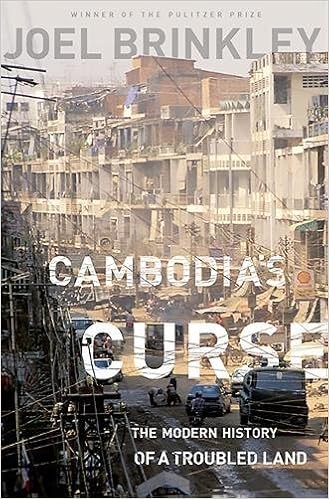
Cambodia's Curse: The Modern History of a Troubled Land

 In 2008 and 2009, Brinkley returned to Cambodia to find out. He discovered a population in the grip of a venal government. He learned that one-third to one-half of Cambodians who lived through the Khmer Rouge era have P.T.S.D.--and its afflictions are being passed to the next generation. His extensive close-up reporting in Cambodia's Curse illuminates the country, its people, and the deep historical roots of its modern-day behavior.


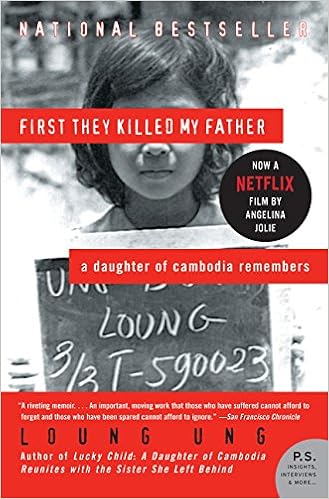
One of seven children of a high-ranking government official, Loung Ung lived a privileged life in the Cambodian capital of Phnom Penh until the age of five. Then, in April 1975, Pol Pot's Khmer Rouge army stormed into the city, forcing Ung's family to flee and, eventually, to disperse. Loung was trained as a child soldier in a work camp for orphans, her siblings were sent to labor camps, and those who survived the horrors would not be reunited until the Khmer Rouge was destroyed.


There are many other fine books that detail that period and its troubling effects, and I recommend you check around and read some. With all that is happening in the world, ignoring the changes going on in SE Asia, given its turbulent history, would be a mistake. 


Canadian in a Cambodian Mindfield; American with a Suitcase Full of Sutras


And I'd be remiss if I didn't mention a lighter book on Cambodia. John Pocock initiated this project when I was living in Kampot, Cambodia. He came up with the idea of using my photographs and a series of mental images that we'd use poetically to capture impressions of the place and time. It seemed like fun.

This book was prepared in 2012 and isn't a serious discussion of anything. It is intended to play with ideas, poetic and visual images, that I encountered living there, and twisting them through two different perspectives.

Sunday, March 9, 2014

An Asian story

Friends and fellow travelers have asked when I'd get around to writing a story from the years living in Asia. I did do a story of a sailor in Hong Kong, called Chancy. That one I wrote with John Pocock and it included wonderful photos by my good friend and former colleague in HK, Tom Tsui. It wasn't really about Asia, though, even though it took place there.

Now I've released a short story (99 cents for an introductory period that is as yet indeterminate) called Imitating Art. This one combines my observations of expats in SE Asia with an experience from my time in the Caribbean. (The cover photo is one I took in Thailand). If you look at the description, I billed it as a crime story, as it is, in a way. I am terrible when it comes to fitting into genre, just as I haven't ever fit well in social niches, and this is really a story about a writer, an expat, in Asia. The crimes (and it refers to more than one) are not really the issue. The title suggests the connection between the crimes and the story.

I am quite happy with this story, and would like to do more along this line, combining my interest in mysteries with explorations of Asia. It's only up on Amazon as an ebook now but it interests readers, then I'll be doing more of these.

Hemingway wrote that you need distance from a place you've been before you could write about it honestly, and I'm just beginning to understand what he meant. I am still writing stories of the Caribbean and, in some rather interesting ways, the place and people are clearer to me than it was when I lived there.  That is just starting to happen with Asia.

To help keep my other stories in front of people and hope they find more readers, I've lowered the price on the ebooks for my Venezuelan murder mystere (book one in the Martin Billings stories, as it is turning out) UNDER LOW SKIES to $3.99 and THE LEGEND OF RON ANEJO (the story of the world's best Caribbean boat bum) and FLOAT STREET NOTES to $2.99. The new prices will be reflected at Amazon and Smashwords later today and ripple through to the other outlets over time (I don't control that).

Sunday, July 29, 2012

Anteaters in Cambodia

You might be familiar with the South American anteater, but Cambodia has some that are quite different. Here is a photo of the female anteater stalking her prey.


She is after large red ants that live in the trees. The trick is to shake the leaves, knocking the ants off the leaves and into that basket at the end of the pole. The bucket is water she will use to get ants off her hands and feet (you didn't think they would sit calmly in the basket did you?)

In this case, after a time, the male anteater (aka Mr. Sau) came along as the relief hunter. Mr. Sau is the gardener here at Dr. Philippe's who is intrigued by Dagny's art and my attempts to speak Khmer without a net.


These trees grow along a stream that feeds into the river, which is a lovely place for insects. You can see the basket in the upper left as he disappears into the tree below. This not only allows him access to the ants at the top, but gives the ants at the bottom access to him, which I take as a fair exchange. Periodically he stops to perform an interesting dance step that probably dates back to the time of Apsara. I wasn't fast enough to get a photo of that. Perhaps another time.


Below is a closeup of the basket. It only has a few ants in it, in fact I saw more on the handle than in the basket, so it was not the best of harvests.


While I know they gather these to eat,(Mr. Sau was very clear on that point) I don't know the recipe yet. Mr. Sau's English and my Khmer are not up to the task of exchanging recipes yet, but perhaps they will invite us over for tea and ants some afternoon. I suspect that, like spiders, they are fried, but that is only speculation at the moment and they will need to catch a lot more ants if they are going to have company.